
How to Identify Triggers Behind Difficult Behaviour in Neurodivergent Children

When a neurodivergent child shouts, refuses, runs away, hits, withdraws or becomes extremely distressed, the behaviour is often the most visible part of a much bigger experience.
The immediate reaction may appear sudden, but it is frequently influenced by what happened beforehand, including demands, sensory input, communication difficulties, fatigue, pain, uncertainty or an unmet need.
Understanding behaviour triggers does not mean excusing harmful behaviour or removing every boundary. It means looking beyond the behaviour so that parents, carers and teachers can respond more effectively and reduce avoidable distress.
NICE recommends assessing possible triggers when autistic children show behaviour that others find difficult. These can include communication needs, physical health, anxiety, ADHD, lighting, noise, routines, social environments and a lack of predictability or structure.
Behaviour is information
Behaviour can communicate something a child is unable to explain clearly at that moment.
A child may be communicating:
This task feels too difficult
I do not understand what is expected
The environment is overwhelming
I need a break
Something hurts
I am tired or hungry
I cannot manage another transition
I need help communicating
I feel anxious or unsafe
I am trying to regain some control
This does not mean adults should guess the meaning of every behaviour. The same behaviour may have different causes on different days.
Instead, look for patterns.
The National Autistic Society notes that distressed behaviour may relate to sensory differences, transitions, unstructured time, communication difficulties, feeling unwell, tiredness or hunger. It recommends recording what happened before, during and after the event to help understand its possible purpose.
What are behaviour triggers?
A trigger is something that contributes to a behavioural or emotional response.
Some triggers are immediate and easy to identify, such as:
A loud alarm
Being told to stop a preferred activity
A change to the usual plan
A difficult instruction
A disagreement with another child
Others are less obvious:
Poor sleep the night before
Hunger
Pain or illness
Several small demands building up
Masking throughout the school day
Background noise
Fear of making a mistake
Not understanding the language being used
Worry about what will happen next
The final event is not always the main cause. It may simply be the point at which the child no longer has enough capacity to cope.
ADHD behaviour triggers and autism behaviour support
Children with ADHD may find frustration, waiting, transitions, interruptions, task initiation and repeated correction particularly difficult.
Autistic children may also experience distress linked to sensory differences, changes in routine, communication difficulties, uncertainty and social demands.
Many children have both ADHD and autism, and their needs may overlap. It is therefore more useful to understand the individual child than to assume a behaviour has one standard cause.
Effective autism behaviour support and ADHD support should examine:
What the child was being asked to do
How the instruction was communicated
What was happening in the environment
Whether the child was tired, hungry or unwell
What sensory information they were managing
What changed unexpectedly
What happened after the behaviour
What need the behaviour may have helped the child meet
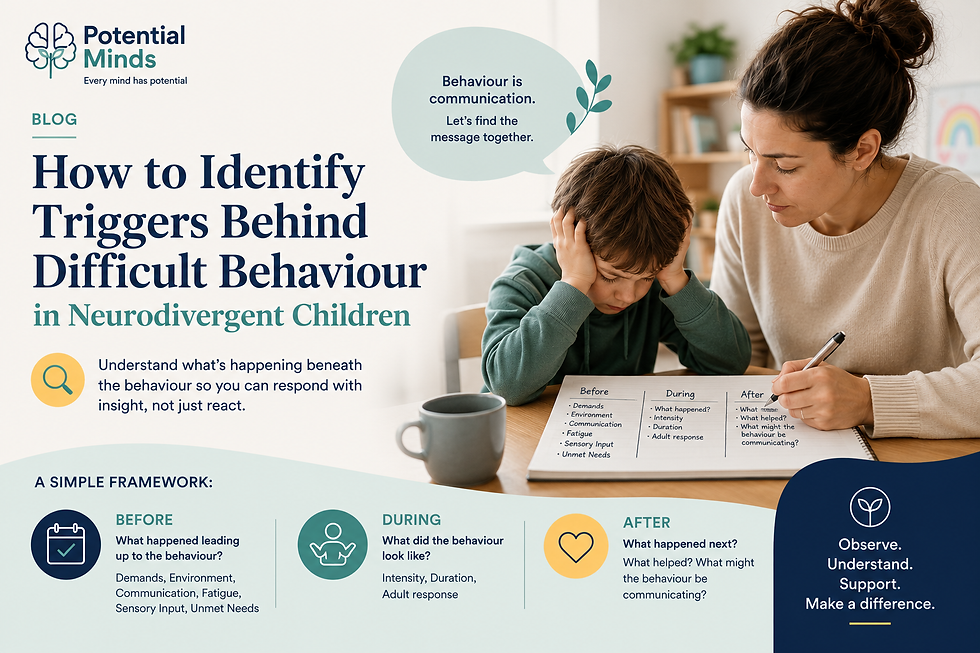
Use a simple before-during-after framework
A practical way to identify behaviour triggers is to record what happened:
Before the behaviour
During the behaviour
After the behaviour
This is sometimes described as an ABC approach:
A: Antecedent, what happened before
B: Behaviour, what the child did
C: Consequence, what happened afterwards
The word “consequence” does not mean punishment. It simply means the events that followed the behaviour.
NICE recommends functional assessment that identifies the situations that predict behaviour, the behaviour itself, its possible purpose and what happens afterwards that may maintain it.
1. Before: What happened leading up to the behaviour?
The “before” section is often the most useful place to begin.
Look back over the minutes or hours before the behaviour and consider the following areas.
Demands
A demand is anything the child is expected to do, stop doing, tolerate or process.
Examples include:
Getting dressed
Starting homework
Leaving the house
Stopping screen time
Answering a question
Sitting still
Waiting
Sharing
Entering a noisy classroom
Moving from one activity to another
Following several instructions
Ask:
Was the task too difficult?
Was the instruction too long?
Were several demands given at once?
Did the child understand what was expected?
Was the child already overwhelmed?
Was the demand unexpected?
Did the child have any choice or control?
A demand that is manageable in the morning may become difficult after a full school day.
What may help
Give one instruction at a time
Use clear, concrete language
Break tasks into smaller steps
Show rather than only tell
Offer two acceptable choices
Build in short breaks
Use visual schedules or checklists
Allow additional processing time
Environment
The physical and social environment can strongly influence behaviour.
Consider:
Noise levels
Bright or flickering lights
Crowds
Temperature
Smells
Visual clutter
Lack of personal space
Unfamiliar people
Several people talking
Conflict nearby
A chaotic classroom
A change of room
NICE specifically recommends considering lighting, noise, the social environment and changes in routine when assessing triggers in autistic children.
What may help
Move to a quieter space
Reduce background noise
Lower lighting where possible
Allow headphones or ear defenders
Seat the child away from busy areas
Provide a predictable calm space
Reduce the number of adults speaking
Prepare the child before entering unfamiliar environments
Communication
A child may become distressed because they:
Do not understand the instruction
Cannot express what they need
Need more processing time
Interpret language literally
Cannot find the words while upset
Feel pressured by repeated questioning
Do not understand why something changed
Are expected to explain themselves too quickly
Communication difficulties are a recognised factor in behaviour that challenges, particularly when a child cannot easily understand situations or express needs and wishes.
What may help
Use shorter sentences
Avoid vague instructions
Give the child time to respond
Use pictures, writing or gestures
Ask one question at a time
Check understanding without testing
Offer communication cards such as “break,” “help,” “too loud” or “not ready”
Avoid demanding explanations during distress
Fatigue, hunger and physical health
A child’s capacity can reduce significantly when they are:
Tired
Hungry
Thirsty
Constipated
In pain
Unwell
Experiencing medication effects
Recovering from a busy day
Emotionally exhausted from masking
Sensory tolerance may also become lower when someone is tired, stressed, hungry or physically unwell.
Ask:
Did the child sleep well?
When did they last eat or drink?
Could they be in pain?
Has their behaviour changed suddenly?
Is the behaviour happening at the same time each day?
Does it occur when medication is wearing off?
Have they had enough recovery time?
A sudden or unexplained change in behaviour should not automatically be attributed to ADHD or autism. Physical discomfort, illness, anxiety, bullying or other factors may need investigation.
Sensory input
Children may be over-sensitive or under-sensitive to:
Sound
Light
Touch
Smell
Taste
Movement
Temperature
Internal body sensations
A child may shout because the room is too loud, remove clothing because the fabric hurts, run because they need movement or refuse food because the texture is overwhelming.
Sensory differences may not always be visible to other people. The same sound that seems minor to an adult may be painful or impossible for the child to filter out.
What may help
Offer noise-reducing headphones
Reduce visual clutter
Allow movement breaks
Adjust clothing expectations
Provide a quieter waiting area
Avoid unexpected touch
Offer familiar sensory tools
Observe which environments repeatedly cause distress
Transitions and changes
Transitions require a child to stop one activity, shift attention and prepare for something new.
Common difficult transitions include:
Leaving home
Entering school
Ending screen time
Moving between lessons
Starting homework
Changing plans
Beginning bedtime
Leaving a preferred activity
Moving from school to home
Unexpected changes and a lack of predictability can increase distress, particularly for autistic children.
What may help
Give advance warning
Use countdowns
Show a visual timetable
Explain what will happen next
Use first-then language
Keep familiar routines where possible
Introduce changes gradually
Prepare an alternative plan
Unmet needs
The behaviour may help the child meet a need.
The child may be trying to:
Escape an overwhelming task
Gain help
Communicate discomfort
Access a preferred activity
Avoid uncertainty
Obtain sensory input
Reduce sensory input
Regain control
Connect with an adult
Protect themselves from embarrassment
Delay something they fear
The goal is not to label the child as manipulative. It is to identify what the behaviour achieves or communicates so that the need can be met in a safer and more effective way.
2. During: What did the behaviour actually look like?
Describe the behaviour objectively.
Avoid vague labels such as:
Naughty
Defiant
Manipulative
Aggressive personality
Attention-seeking
Out of control
Instead, record what you observed:
Shouted for three minutes
Covered ears and moved under the table
Pushed the workbook away
Repeated “no” several times
Left the room
Hit their own head
Threw two objects
Stopped speaking
Cried and lay on the floor
Asked the same question repeatedly
Also record:
How long it lasted
How intense it was
Whether anyone was at risk
Whether speech reduced
Whether the child sought or avoided contact
Whether the behaviour escalated gradually or suddenly
What adults did during the event
Objective descriptions make it easier to compare events and notice patterns.
Early warning signs
There may be a period before the peak behaviour when the child begins to show signs of increasing stress.
These may include:
Pacing
Faster speech
Repeated questions
Increased movement
Covering ears
Becoming very quiet
Refusing small requests
Clenching fists
Hiding
Seeking reassurance
Saying “I cannot”
Becoming more sensitive to touch or sound
Recognising these signs can create an opportunity to reduce demands or offer support earlier.
3. After: What happened next?
What happens after a behaviour can help explain its possible purpose.
Record:
Was the task removed?
Did the child leave the environment?
Did an adult provide comfort?
Did everyone stop talking?
Was the child given an item or activity?
Did the child gain additional attention?
Was the child punished?
Did the situation become quieter?
Did the child appear relieved?
How long did recovery take?
This does not mean the adult caused the behaviour. It means the outcome may unintentionally make the behaviour more likely to happen again because it successfully met a need.
For example:
If shouting consistently removes a confusing task, the behaviour may function as escape.
If running away leads to a quieter environment, the behaviour may reduce sensory overload.
If hitting results in immediate adult attention, the child may need a safer way to request connection or help.
If refusal delays a difficult transition, more preparation may be needed.
The response should address the need while teaching or supporting a safer alternative.
A simple behaviour trigger record
Use a table like this:
Before | During | After |
Homework began immediately after school. The room was noisy. The child had not eaten. | Child shouted, pushed the workbook away and hid under the table. | Homework stopped. Parent reduced noise and offered food. Child recovered after 20 minutes. |
Possible interpretation:
Fatigue after school
Hunger
Noise
Demand introduced too quickly
Need for decompression before homework
Possible adjustment:
Snack and quiet time first
Visual homework plan
One short task at a time
Reduced background noise
Planned break after ten minutes
This is a hypothesis, not a certainty. Continue observing before drawing conclusions.
Questions to ask after several incidents
After recording several events, look for repeated patterns.
Ask:
Time and place
Does it happen at a particular time?
Is it more common at school, home or in public?
Does it occur at the end of the day?
Is one room or environment involved?
Demands
Which tasks are usually present?
Does the behaviour happen when the child must stop something?
Are instructions unclear or too long?
Is the demand beyond the child’s current skills?
Communication
Can the child ask for help, a break or more time?
Are adults asking too many questions?
Does the child understand what will happen next?
Sensory input
Is the environment loud, bright, crowded or uncomfortable?
Is touch involved?
Does the child seek movement or pressure?
Does sensory tolerance reduce when they are tired?
Physical and emotional factors
Is the child hungry, tired, anxious or in pain?
Has there been a change in sleep?
Is medication timing relevant?
Has something changed at home or school?
Outcomes
What usually happens after the behaviour?
Does the child escape a task?
Gain quiet?
Receive support?
Delay a transition?
Obtain a preferred activity?
Responding to the trigger, not just the behaviour
Once a likely trigger has been identified, adjust what happens before the behaviour.
Examples:
Possible trigger | Supportive adjustment |
Too many instructions | Give one step at a time |
Sensory overload | Reduce noise, light or crowding |
Difficult transition | Use warnings and visual schedules |
Communication difficulty | Provide visual or written choices |
Fatigue after school | Allow decompression before demands |
Hunger | Plan regular snacks |
Task too difficult | Break it into smaller parts |
Uncertainty | Explain what will happen next |
Need for escape | Teach a safe way to request a break |
Need for connection | Schedule positive adult attention |
The most effective support often changes the environment and communication rather than expecting the child to tolerate repeated overwhelm.
Teach alternative communication
Once the child is calm, support them to communicate the need in another way.
Possible alternatives include:
“Break please”
“Too loud”
“Help me”
“Not ready”
“I need more time”
“Something hurts”
Showing a card
Pointing to a symbol
Using a gesture
Moving to a designated calm space
These alternatives should be practised during calm periods, not introduced for the first time during crisis.
Keep the approach compassionate
Tracking behaviour should never become surveillance, blame or punishment.
Avoid using the record to prove that the child is the problem.
Instead, ask:
What is the child finding difficult?
What might they be trying to communicate?
What changes can adults make?
What skill needs support?
How can we reduce shame?
How can we protect safety and dignity?
The NHS advises making the child’s surroundings comfortable, managing light and noise, maintaining familiar routines and preparing them for changes.
Work consistently across home and school
Patterns may be easier to identify when parents, carers, teachers and professionals share observations.
A child may appear calm at school but become distressed at home because they have used significant energy coping throughout the day.
Alternatively, a trigger may be specific to one environment.
Useful information to share includes:
Early warning signs
Communication preferences
Sensory needs
Helpful regulation strategies
Difficult transitions
Common triggers
Recovery needs
What adults should avoid
NICE recommends consistency across settings and agreement among families, carers and professionals when implementing behaviour support.
When to seek professional support
Seek advice from a GP, paediatrician, psychologist, occupational therapist, speech and language therapist, school SENCO or another appropriately qualified professional when:
The behaviour is increasing in frequency or intensity
The child is hurting themselves or others
There is a sudden change from their usual behaviour
Pain or illness may be involved
The child cannot access school or everyday activities
Communication needs are not being met
Sensory difficulties are significantly affecting daily life
The family or school cannot manage safely
Existing strategies are not helping
Professional assessment should consider physical health, mental health, communication, sensory needs and environmental factors rather than assuming the behaviour is simply part of autism or ADHD.
How NeuroCoach may help
NeuroCoach is designed to help parents, carers and neurodivergent individuals capture difficult moments and explore possible triggers.
It can support users to record:
What happened before the behaviour
The demand or transition involved
Environmental and sensory factors
Communication difficulties
Fatigue, hunger or physical discomfort
What the behaviour looked like
What happened afterwards
Which strategies appeared helpful
Patterns that emerge over time
The purpose is not to judge or control behaviour. It is to build a clearer understanding of what the child may need.
NeuroCoach is a coaching and wellbeing support tool. It does not provide diagnosis, therapy, medical advice, crisis intervention or emergency support.
Final thoughts
Difficult behaviour is rarely random.
It may be connected to demands, sensory overload, communication difficulties, transitions, fatigue, pain, uncertainty or an unmet need.
A simple before-during-after framework can help adults move from reacting only to the visible behaviour toward understanding the conditions that contributed to it.
The most useful question is often not:
“How do we stop this behaviour?”
It is:
“What is this child experiencing, and what support or adjustment could help?”
That shift can lead to safer responses, stronger relationships and more effective support.


Comments